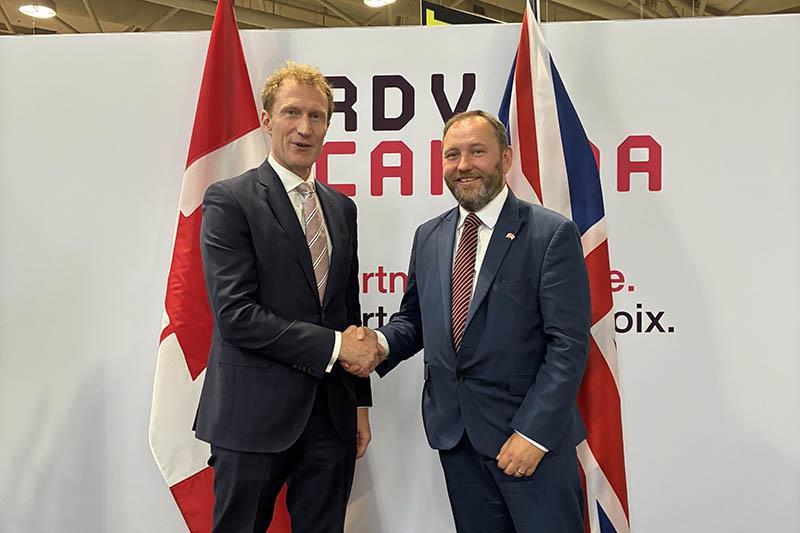
UK and Canada updated their co-production treaty at TIFF, boosting flexibility, funding, and digital scope for film/TV producers, enhancing creative partnerships.
In a significant development for global cinema collaboration, the United Kingdom and Canada have formally inked an updated co-production treaty, expanding its scope to embrace digital platforms and offering unprecedented financial and creative flexibility for producers. The signing, a highlight of the recent Toronto International Film Festival (TIFF), saw UK Creative Industries Minister Ian Murray and his Canadian counterpart Marc Miller finalize the agreement on September 13, marking a new chapter for transatlantic film and television ventures.
Toronto’s Catalyst: Modernizing UK-Canada Co-production for a Digital Era
The newly ratified treaty, an evolution of an initial pact signed in 1975, is poised to reshape how films and television series are conceived, financed, and brought to audiences across the two nations. A core tenet of this modernized agreement is the provision that co-produced projects will receive the same treatment as wholly domestic productions in both countries. This critically important clause unlocks greater access to national funding mechanisms and tax incentives, which are vital lifelines for many productions, particularly independent film. Producers can also expect enhanced flexibility in structuring projects, clearer guidelines regarding copyright ownership and revenue sharing, and robust guarantees around distribution and broadcast, ensuring that creative works find their intended global viewership.
Harriet Finney, the BFI’s deputy chief executive, underscored the treaty’s practical benefits for the industry. “The treaty…recognises the major shifts we’ve seen in our sector,” Finney noted in a statement, “where building finance for new film and television projects now regularly requires numerous partners and territories. Providing greater flexibility and covering both film and television, there is now more scope for UK producers to look to Canada for their next creative partner.” This sentiment reflects the increasing complexity of film finance and the necessity for agile, internationally focused frameworks to support diverse storytelling.
Historically, the collaboration has been fruitful. Since 2015, the UK and Canada have engaged in 98 co-productions, yielding notable projects such as the BAFTA-winning 2015 film Brooklyn (a co-production also involving Ireland), the Netflix series Geek Girls, and Pablo Trapero’s & Sons, which had its premiere at TIFF last year. This established legacy provides a strong foundation for the expanded opportunities presented by the new agreement, setting the stage for more ambitious and innovative projects to seek an international distribution deal.
Strategic Storytelling: Adapting to Global Shifts in the Audiovisual Landscape
The significance of this treaty extends far beyond mere administrative updates; it represents a strategic embrace of global change within the audiovisual sector. In an industry increasingly defined by streaming platforms, diverse content demands, and evolving consumption habits, such international alliances are critical. This agreement directly addresses the shift towards digital distribution, ensuring that co-productions are inherently designed for a multi-platform world, which is a major draw for potential acquisition partners at any major film festival. For independent film creators, this means a larger canvas for their narratives and a more robust pathway to global audiences, bypassing some of the traditional gatekeepers.
At TIFF, Minister Murray articulated the broader philosophical underpinnings of the treaty. “We need this co-production treaty for a number of reasons,” he stated, “One is that we are close historic allies in an increasingly fraught world. And what we need to do through audiovisual is to tell our stories… It’s the only way in which we learn about each other’s cultures and are able to do these treaties in order to be able to work together because we understand each other in an ever increasingly divisive world. That’s more important today than it’s ever been, particularly when some of our allies are not as close as they perhaps should be.” His words highlight the cultural diplomacy inherent in such agreements, using the medium of film and television to foster mutual understanding and connection.
Echoing this perspective, Minister Miller emphasized the need for adaptability and ambition in a rapidly transforming global order. “The old rules-based international order is effectively gone, and it’s hard to see it coming back as technology, geopolitics, and economic pressures put the strength of our values to the test,” Miller observed. “The question is not whether we adapt to this reality, but how we must. It’s also whether we adapt by building higher walls or whether we can do something that should be more ambitious. And I think it’s safe to say that Canada chooses ambition.” This forward-looking stance positions the treaty not just as a regulatory update, but as a proactive strategy to maintain cultural and economic sovereignty through collaborative creativity.
In a further statement, Miller celebrated Canada’s audiovisual sector, known for its “world-class talent, innovation and stories.” He added, “ensuring it remains competitive in an increasingly digital world is key. These modernised coproduction agreements will make it easier for our filmmakers to collaborate with partners around the world, bring Canadian stories to new audiences, and strengthen our audiovisual industry as a pillar of our cultural and economic sovereignty.” The focus on competitiveness and sovereignty underscores the dual benefits – cultural enrichment and economic growth – that such a robust co-production framework promises.
The Road Ahead: Future Implications for Global Film Festivals and Beyond
While the treaty has been signed, it still requires formal ratification to become fully operational. Once enacted, its impact is expected to be profound, fostering a surge in collaborative projects and diversifying the international independent film landscape. We anticipate seeing an increased number of UK-Canada co-productions making their premiere at leading film festivals worldwide, attracting significant acquisition interest, and securing robust distribution deals. This agreement serves as a blueprint for how nations can strategically partner to navigate the complexities of the modern media environment, ensuring that rich narratives continue to flow across borders and reach diverse audiences. The global film festival circuit will undoubtedly be watching closely for the first wave of projects to emerge from this ambitious and vital new partnership.
Quick Facts
What is the purpose of the updated UK-Canada co-production treaty?
The updated UK-Canada co-production treaty aims to modernise the agreement, include digital platforms, and increase financial and creative flexibility for producers.
Who signed the new co-production treaty between the UK and Canada?
The treaty was signed by UK culture minister Ian Murray and his Canadian counterpart Marc Miller.
What benefits does the new UK-Canada co-production treaty offer filmmakers?
The treaty offers filmmakers greater access to national funding and tax incentives, more flexibility, clearer rules on sharing copyright and revenue, and stronger guarantees for distribution and broadcast.
Related Festivals: Toronto International Film Festival, Cannes Film Festival, Venice Film Festival
Tags: Toronto Film Festival 2026, UK Canada co-production, audiovisual industry treaty, digital platforms content, film TV funding incentives