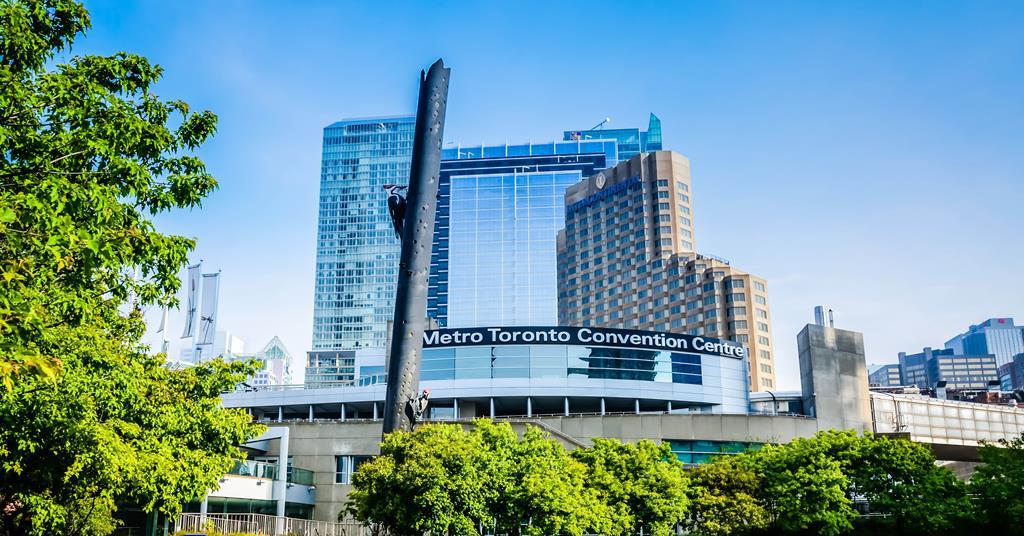
Inaugural TIFF: The Market earned mixed reviews. Buyers reported sales, yet many found the “work in progress” market had operational issues, despite strong delegate numbers.
Metro Toronto Convention Centre. Source: Sandra Foyt / Shutterstock
The inaugural TIFF: The Market, which ran from September 10-16 alongside the esteemed Toronto International Film Festival, has concluded, revealing a spectrum of initial impressions from global buyers and sellers. While official figures from market head Charles Tremblay tout impressive attendance and delegate numbers, a deeper dive into industry feedback paints a nuanced picture, highlighting both the successes of the new initiative and the considerable learning curve for this ambitious addition to the global film festival circuit. This initial foray into a formalized market structure aimed to cement Toronto’s position as a major hub for film acquisition and distribution deals, especially for independent film, but its reception suggests a need for refinement in the years to come.
TIFF’s Market Debut: Navigating New Terrain in Toronto
The decision by the Toronto International Film Festival to launch a dedicated market, backed by substantial Canadian federal funding of US $16.5 million (C$23 million) over three years, signifies a significant play in the global film industry landscape. It’s an effort to formalize the bustling “shadow market” that has long organically co-existed with the film festival. While the Metro Toronto Convention Centre served as the market’s central hub, housing dozens of exhibition stands, a speaker summit, and an Innovation Hub, its atmosphere was described by many as a “work in progress.” Foot traffic was inconsistent, and crowds often thinned by the afternoon, with the exception of the always-vibrant Canadian umbrella stand.
Initial logistical challenges, particularly the notoriously long queues for accreditation badges, cast a shadow over the opening days. Reports of four-hour waits due to volume and printer malfunctions were widespread. However, market organizers swiftly responded by offering digital passes and managed to resolve the backlog, with many attendees attributing these issues to “growing pains” inherent in any large-scale debut. Despite these hurdles, Charles Tremblay, TIFF: The Market head, reported a significant increase in delegate numbers, stating,
— Charles Tremblay, TIFF: The Market head
Tremblay highlighted that over 116,000 attendees participated in market events, with more than 7,000 registered delegates from 92 countries – surpassing the initial target of 6,000. Additionally, buyer attendance saw a 19% increase from 2025, with 1,473 buyers actively engaged in meetings and 196 market screenings.
Toronto’s Sales & Acquisitions Arena: Early Wins and Lingering Questions
For many top-tier sales agents and independent film distributors, the question wasn’t if Toronto offered a viable platform, but how best to engage with its newly structured market. Many US and UK sellers, accustomed to their established routines, opted to conduct meetings off-site at hotels like Soho House or the Ritz-Carlton, as they have done for years. This underscores a reluctance to fully abandon proven strategies in favor of the new official footprint.
Fabien Westerhoff, Managing Director of Global Constellation’s theatrical film division, observed positive outcomes from his company’s presence:
— Fabien Westerhoff, Global Constellation
Similarly, Glen Basner, Founder and CEO of FilmNation, who also operated off-site, found the combined festival and market experience “highly productive,” leading to new sales and critical discussions for upcoming releases. Nicolas Chartier, CEO of Voltage Pictures, also reported a productive film festival, citing strong international sales for their romantic comedy, I Wish I Never Had Sex With Him.
However, not all experiences were uniformly positive regarding the convention center. Spencer Pollard, CEO of Kaleidoscope, who screened the world premiere of John Madden’s Onwards And Sideways, articulated frustrations:
— Spencer Pollard, Kaleidoscope
The timing of TIFF: The Market, so soon after the European summer holidays, also posed a challenge for many sales companies in packaging new projects, with many opting to use Toronto as a preparatory phase for the upcoming American Film Market (AFM). As Nat McCormick, co-head of worldwide sales and distribution at AGC Studios, noted,
— Nat McCormick, AGC Studios
On the domestic acquisition front, US buyers noted a less commercial selection of films at the 51st edition of the Toronto International Film Festival compared to previous years. However, this did not deter significant activity, highlighted by Universal and Blumhouse Atomic Monster’s impressive multi-million dollar acquisition of US rights for River from Midnight Madness, a notable distribution deal. Eleonora Pesci, Curzon’s head of acquisitions, reflected a sentiment of cautious optimism:
— Eleonora Pesci, Curzon
Echoing this, Richard Lorber of Kino Lorber commented on the festival’s offerings, stating,
— Richard Lorber, Kino Lorber
Despite the mixed reception for the market’s physical infrastructure, the underlying strength of the Toronto International Film Festival as a launchpad for world premieres and an essential networking event for film professionals remains undeniable. The one-on-one meetings, the creative development programmes, and the buzz around compelling independent film titles continued to drive engagement.
Looking Ahead: The Future of Film Business at the Toronto Film Festival
The debut of TIFF: The Market represents a significant industry trend: major film festivals increasingly seeking to consolidate their market functions. This move impacts the global calendar, particularly how it positions itself against established events like the Cannes Film Market and the American Film Market in November. The insights gleaned from this inaugural year will be crucial in shaping future iterations. The challenge for TIFF will be to evolve its market offering to integrate more seamlessly with existing industry practices while still attracting top-tier talent and securing significant distribution deals.
As the dust settles, the industry will be closely watching for further acquisition announcements and the long-term impact of this market on the trajectory of independent film. Expect discussions to continue about the optimal timing for a fall market, its physical layout, and how to best serve the diverse needs of sellers, buyers, and filmmakers. The next American Film Market (AFM) in Los Angeles, scheduled for November 10-16, will provide another crucial benchmark for comparing market activity and gauging the overall health of the independent film sector post-Toronto. The film festival community eagerly anticipates how Toronto will refine its market strategy for 2027 and beyond, aiming to solidify its status as an indispensable event for film acquisition and global cinematic exchange.
Quick Facts
When was the inaugural TIFF: The Market held?
The first TIFF: The Market took place from September 10-16, with the festival running from September 10-20.
What were the initial impressions of the inaugural TIFF: The Market from participants?
Buyers and sellers who attended the inaugural TIFF: The Market reported mixed initial impressions, reflecting a range of opinions on the new offering.
How many delegates attended the first TIFF: The Market?
The inaugural TIFF: The Market attracted 7,010 registered delegates from 92 countries, exceeding its target of 6,000.
Related Festivals: TIFF, Cannes, Venice, Telluride
Tags: TIFF: The Market 2026, film sales, film acquisition, international film market, Toronto film industry